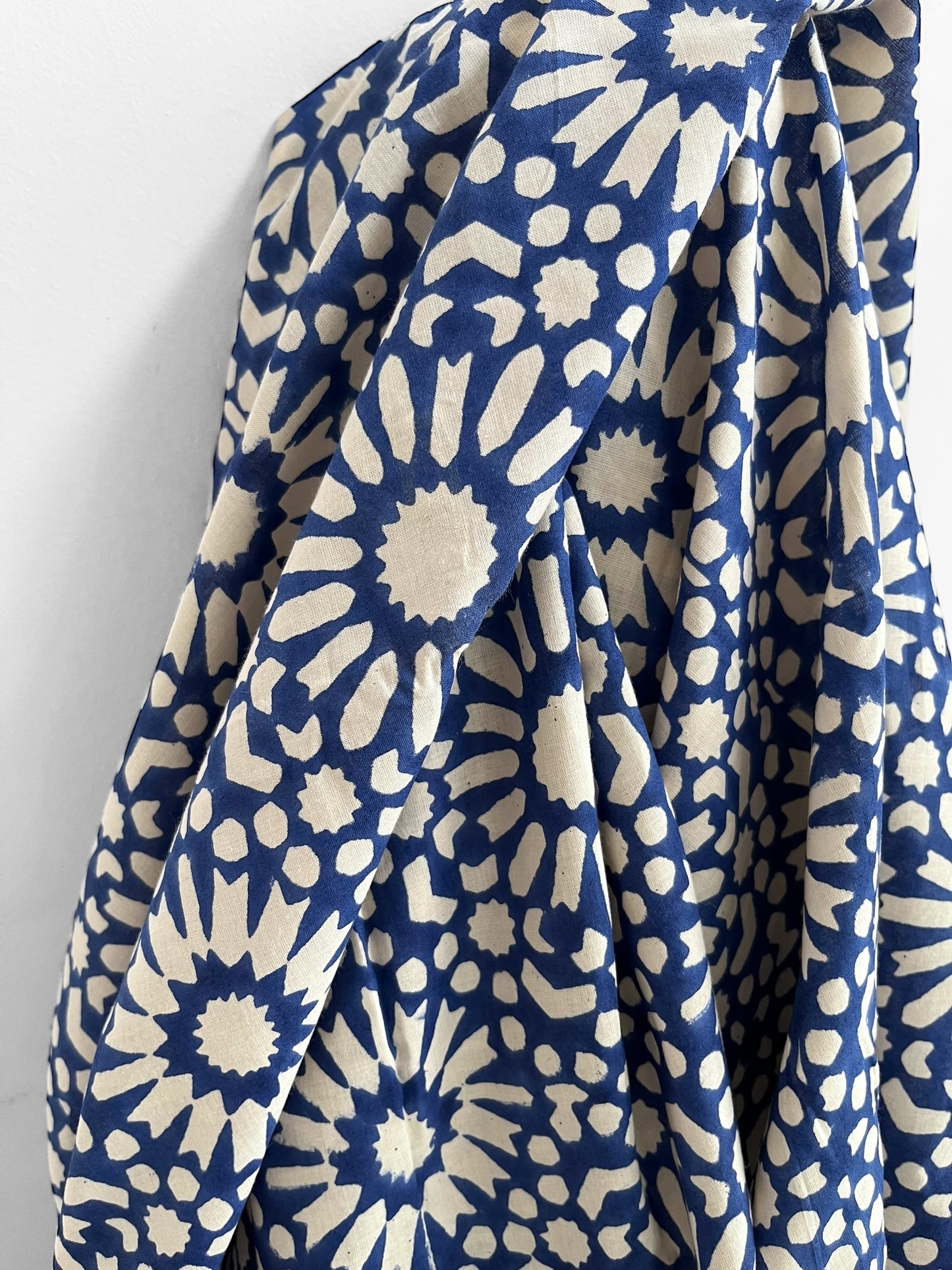


Block Print Cotton by Merchant and Mills
Papercut Blue
Papercut Blue
Couldn't load pickup availability
A striking Bagru block print in blue and a warm stone shade. Bagru, a small village in Rajasthan, 35 kilometres from Jaipur, is known for its hand block printing utilising traditional processes and natural colours. Bagru prints tend to be more simple with limited colours in comparison to Sanganer block prints which are more colourful with finer detail. Block printing is still practiced by the Chippa community, who have lived here for over 400 years.
Papercut is suitable for tops, and dresses and skirts with fullness. You could also use this block print for home projects like small curtains or scatter cushions.
Please note that the maximum continuous length of this fabric is 10m
-----
- Composition: 100% COTTON
- Width: 114cm
- Weight: 81 gsm (lightweight, similar to voile)
Please note: Indian hand-printed cloths are sometimes susceptible to irregularities in the print, this is all part of their charm and are not classed as flaws.
This fabric is hand dyed. For the couple of washes, place the fabric in the washing machine drum at 30 or 40 degrees with a handful of table salt. This will fix the dye to prevent it from running.
-----
CARE
CARE
Wash at 30 degrees with a mild bleach-free detergent. Do not tumble dry. Shake out and dry flat. Both linen and hemp will always seize up after washing but as soon as you start to use/wear it the fibres relax again.
If you are using this linen for curtains we recommend using a lining to prevent fading.
Never dry in direct sunlight as the colour can bleach and fade.
SHIPPING
SHIPPING
AUSTRALIA
standard - AUD 15 flat rate
express - AUD 20 flat rate
NEW ZEALAND
standard - NZD 30 flat rate
express - please contact us for a quote
For more details on processing and shipping, including estimated delivery times, please click here
WHY LINEN?
WHY LINEN?
Breathable, durable, hypoallergenic, eco-friendly - linen has it all!
Linen is naturally stain resistant, does not pile, and is moth repellent. It is easy to wash as it can sustain high temperatures, is has very little if no shrinkage and is very strong.
It is anti-bacterial, anti-fungal, hypo allergenic and thermoregulating, it will also absorb up 20% moisture before feeling damp.
As the linen fibres have low elasticity (which causes it to crease) it will wear in any areas that are repeatedly folded in the same place for a long time, however it does have much better abrasion resistance than say cotton.
Eco-credentials
Flax is a strong plant best grown in northern Europe. It needs little or no fertilisers and due to the local climate, little extra water. It doesn’t really require many pesticides either as it can grow in poor quality soil. The Advisory Commission Report to the European Parliament stated that flax cultivation has positive effects on eco-system diversity as it allows for an “environmental pause”. One hectare of flax can retain 3.7 tonnes of CO2. Every part of the plant is used, what isn’t used to produce linen can be used to make linseed oil, paper, cattle feed or even soap.
Linen is therefore almost naturally organic. It is completely biodegradable, recyclable and due to its natural absorbency, it requires less dye than cotton. Linen therefore scores high on the ecological chart.
Share